
Όταν σκεφτόμαστε την έννοια της επικοινωνίας, συχνά τη συνδέουμε με ζώα και ανθρώπους. Τα φυτά όμως, παρόλο που δεν διαθέτουν νευρικό σύστημα, δεν είναι παθητικοί οργανισμοί. Αντιθέτως, αντιλαμβάνονται συνεχώς το περιβάλλον τους και αντιδρούν σε διάφορα ερεθίσματα όπως το φως, το νερό, η βαρύτητα, η αφή. Αυτές οι αντιδράσεις βασίζονται σε πολύπλοκους μηχανισμούς που περιλαμβάνουν ηλεκτρικά σήματα. Όταν ένα φυτό δέχεται ένα ερέθισμα, παράγονται μικρές μεταβολές το ηλεκτρικό δυναμικό των κυττάρων του. Τα σήματα αυτά λειτουργούν ως εσωτερικά μηνύματα, που βοηθούν το φυτό να προσαρμοστεί και να επιβιώσει.
Με τη βοήθεια της σύγχρονης τεχνολογίας μπορούμε να ανιχνεύσουμε αυτά τα “αόρατα” ηλεκτρικά σήματα και να τα μετατρέψουμε σε ήχο. Έτσι, με ένα τρόπο σχεδόν μαγικό τα φυτά αρχίζουν να μιλούν, όχι με λέξεις αλλά με ήχους.
Με αυτή τη λογική σχεδιάστηκε ένα εργαστηριακό μάθημα για μαθητές της Β’ Γυμνασίου με τη βοήθεια της πλατφόρμας Magic School AI. Το εργαλείο που αξιοποιήθηκε ήταν το Science Labs.
Η ποιότητα των αποτελεσμάτων που παράγει ένα εργαλείο τεχνητής νοημοσύνης σαν το Magic School εξαρτάται σε μεγάλο βαθμό από τις οδηγίες που του δίνουμε (promts). Η συγκεκριμένη πλατφόρμα λειτουργεί υποστηρικτικά για τον εκπαιδευτικό και τον καθοδηγεί μέσα από έτοιμα ξεκάθαρα πεδία.
Για τη συγκεκριμένη εφαρμογή δόθηκαν τα εξής promts:



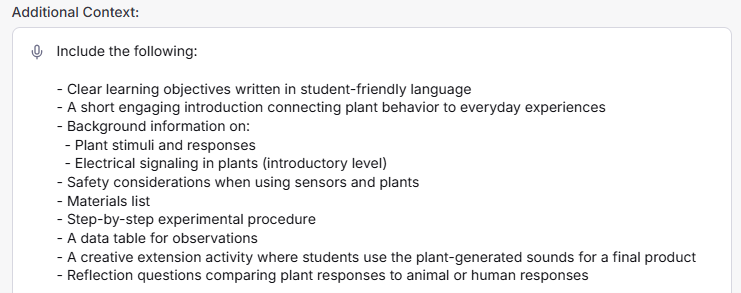
Τα αποτελέσματα που πήρα:
Introduction
Plants may seem immobile and passive, but they actively respond to their environment. Just like how you might squint in bright sunlight or pull your hand back from a hot object, plants move and grow in response to stimuli. In this lab, you’ll discover how plants “talk” and react to light, water, and touch.
Background Information
Plant Stimuli and Responses:
- Phototropism: Plants grow towards light to maximize photosynthesis.
- Hydrotropism: Roots grow towards moisture to access water.
- Thigmotropism: Some plants change growth patterns in response to touch.
Electrical Signaling in Plants:
Plants use electrical signals to communicate internally. These signals can be detected with sensors and converted into sound, allowing us to “hear” plant responses.
Safety Considerations
- Handle all equipment, including sensors and plants, with care.
- Follow all school safety protocols when using electrical equipment.
- Avoid exposing sensors to water or direct contact with plant sap.
Materials List
- Plant biofeedback sensors
- Potted plants (e.g., beans)
- Light sources (e.g., lamps)
- Watering can or spray bottle
- Soft brushes or sticks for touch
- Recording device (e.g., smartphone)
Experimental Procedure
- Setup:
- Attach biofeedback sensors to the plant leaves.
- Ensure all equipment is properly connected and functioning.
- Phototropism Experiment:
- Shine a light on one side of the plant.
- Observe and record the sound changes.
- Hydrotropism Experiment:
- Water one side of the plant’s roots.
- Observe and record the sound changes.
- Thigmotropism Experiment:
- Gently touch the plant leaves with a brush.
- Observe and record the sound changes.
- Data Recording:
- Use the data table below to note observations for each stimulus.
Data Table
| Stimulus | Observation Description | Sound Change |
|---|---|---|
| Light | ||
| Water | ||
| Touch |
Creative Extension Activity
- Use the recorded plant sounds to create a short audio story or an artistic representation of plant responses.
- Share your project with the class and explain the connection between the sounds and plant behaviors.
Reflection Questions
- How do plant responses compare to animal or human responses to stimuli?
- What surprised you about how plants react to different stimuli?
- How did the creative project help you understand plant communication?
Assessment
- Participation in experiments and data recording.
- Creative project presentation and explanation.
Standards Addressed
- MS-LS1-4: Use argument based on empirical evidence and scientific reasoning to support an explanation for how characteristic animal behaviors and specialized plant structures affect the probability of successful reproduction of animals and plants respectively.
- MS-ETS1: Engineering Design.
Ensure the lab is conducted following all safety guidelines and school policies.